

Ferdinand Mural: The Story
Art, craftsmanship and innovation have long been an integral part of Ferdinand’s rich history. From the craft of woodworking that evolved into a thriving furniture manufacturing hub to the architecture of historic buildings, as well as inventions to improve life on the farm and creative entertainment outlets from quilting to music — this mural celebrates the people, landmarks, stories, and innovations unique to Ferdinand, Indiana.
Created by mural artist Adam Long in 2026 and made possible through a partnership between Traditional Arts Today, historic Fleig’s Cafe, Framing Ferdinand, Ferdinand Historical Society, Ferdinand Merchants, Ferdinand Tourism, and the generosity of the community, this mural serves as a reminder of our past and an inspiration for our future!
“While paint is the tool, people are the purpose. A wall has the ability to gather strangers around a common story and remind a community of what it shares.” –mural artist Adam Long


Ferdinand, Indiana was founded in 1840 by Fr. Joseph Kundek. He purchased land and nailed a sign wood-burned with “Ferdinand" to a tree. The missionary priest then began recruiting German Catholics to emigrate to this new town. The first settlers were surprised when they arrived and discovered they needed to build the town themselves. Some moved on, but others stayed.

Between 1845 and 1848 Fr. Kundek oversaw construction of St. Ferdinand Church (now Christ the King Parish). Parishioners served as laborers and were paid for their day’s work with minimal funds but an excess of hearty beverages.

The town’s original settlers were farmers who cleared the hardwood forests to raise cattle and grow crops for their homesteads. In addition to farming, the forests provided lumber for furniture manufacturing.
In 1864 Ferdinand Farmers Insurance was established to provide insurance coverage for the farming community. The business has expanded over the years and continues today. At the end of the 19th century, Ferdinand contained many businesses, including a machine works, a brick works, brewery, several taverns, and a dairy. Farming and furniture manufacturing are still the main economic engines of the community.

Shortly after Ferdinand was founded, Michael Spath established a horse-powered grist mill. The Peter Müller Sr. family purchased the mill and over many years upgraded operations and produced fine quality flour.
Peter Müller, Jr. and his wife Caroline built the red brick Georgian/Italianate house in 1865, which now serves as the home of Traditional Arts Today, a non-profit that offers art classes, sells the work of local artists, and builds community connections by providing spaces for people to gather, share stories, and be creative.

Education was essential. Because of language barriers, German-speaking Sisters of St. Benedict arrived in 1867 to teach the children. They established Convent (now Monastery) Immaculate Conception. In 1870 the sisters opened a boarding school for girls that operated until 2000. They built their “Castle on the Hill” in 1886 which still serves as their home.

Fr. Eberhard Stadler oversaw the building of the Chapel of Our Sorrowful Mother on Mount Calvary hill in 1887, which provided a place of comfort for the bereaved. Today, it is an active columbarium. He also beautified St. Ferdinand Church which included adding clocks to the church tower, a first for the area.

In 1903, Dr. Alois Wollenmann commissioned Seufert Construction to build a Swiss Chalet-Craftsman style house that also served as his clinic. He cared for community members as well as the native people who still inhabited the area.
Dr Wollenmann mentored an African American woman named Ida Hagen, who became the first licensed female pharmacist and first Black female post master in the state of Indiana. Dr. Wollenmann’s home now houses the Main Street Bistro.
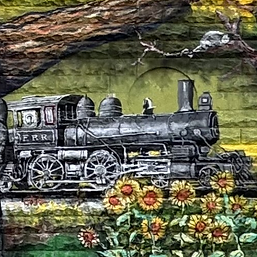
The Ferdinand Commerce Club, established in 1906, realized the importance of connectivity with the outside world. Trains were needed and the closest connection would be neighboring Huntingburg. As a result, 6.48 miles of train track were laid between the two towns.
The Ferdy Flyer began operating in 1908. This train was thought to be the shortest independently-owned railroad in the nation during its 85 years of operation.

On the West wall is a whimsical depiction of the virgin forests of the area. Ferdinand’s immigrants came from all over Germany: Alsace, Baden, Bavaria/Pflaz, Hannover, Hesse, Darmstadt, Prussia, Rhine, Westphalia, Saxony and others. For these immigrants the virgin forests felt like home.
The animals playing instruments are wearing 19th century German festival clothing.

During the Great Depression, a local conservation club acquired 900 acres of land to build a lake and create a hunting and fishing reserve. In 1934 ownership was transferred to the state, a Civilian Conservation Corps (CCC) work camp was established, and the Ferdinand State Forest was born. The CCC built roads, service buildings, a 40-acre reservoir, and a fire tower. Today the Forest spans over 7,600 acres and provides opportunities for camping, hiking, mountain biking, hunting, fishing, swimming, and more.